
Help your staff recognise phishing, suspicious emails and online scams before a simple mistake becomes a bigger problem; Cyber Security Awareness Training will help
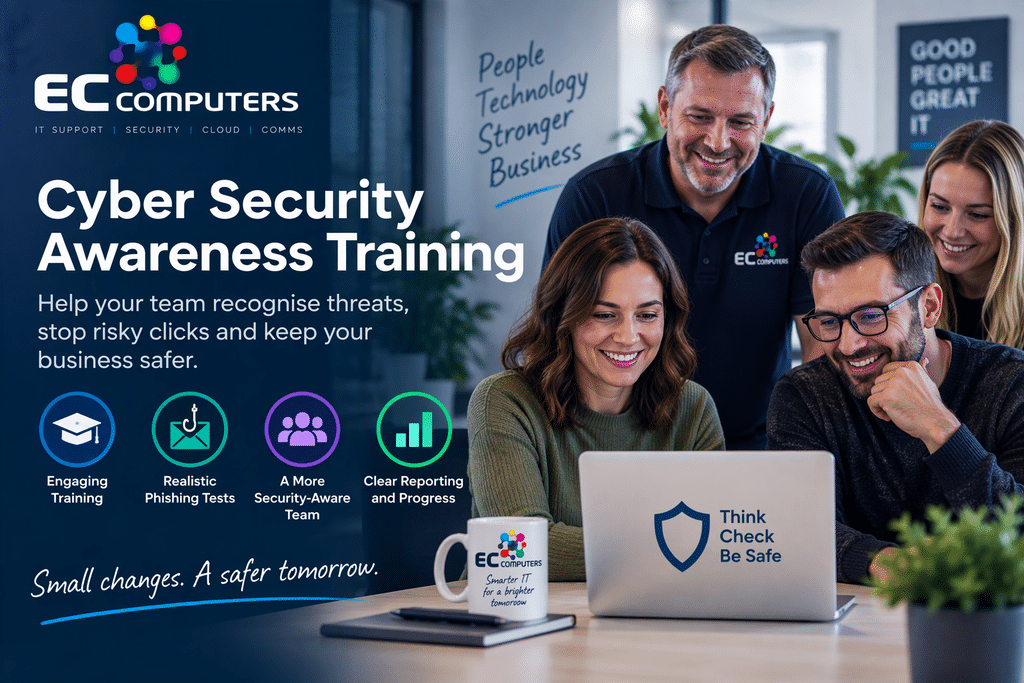
Technology can stop many cyber threats. But sometimes the person receiving the email, clicking the link or approving the sign-in request is the last line of defence.
EC Computers provides practical cyber security awareness training that helps your whole team recognise the warning signs and know what to do when something doesn’t look right.
Short, regular training combined with realistic phishing simulations helps build better security habits without taking your team away from their day jobs for hours at a time.
Talk to us about security awareness training
Your Staff Are an Important Part of Your Cyber Security
Firewalls, antivirus, email security and multi-factor authentication all help protect your business.
But criminals know that sometimes it’s easier to trick a person than attack the technology protecting them.
They might try to persuade someone to:
- Click a link in a convincing phishing email
- Enter their Microsoft 365 password into a fake sign-in page
- Open a malicious attachment
- Approve an unexpected multi-factor authentication request
- Trust an email asking for bank details to be changed
- Respond to someone pretending to be a colleague, customer or supplier
And being confident with technology doesn’t necessarily mean someone will recognise a scam.
That’s why cyber security awareness training shouldn’t just be for the people who are considered “less technical”.
Everyone has a part to play.
Simple, Ongoing Security Awareness Training
Cyber security training doesn’t need to mean taking everyone away from work for a day-long classroom session.
We favour shorter, practical training delivered regularly throughout the year.
Employees learn about the threats they’re actually likely to encounter, including phishing, password security, data protection and social engineering.
The aim isn’t to turn your staff into cyber security experts.
It’s to give them enough knowledge to stop and think when something doesn’t look quite right.
Realistic Phishing Simulations
It’s one thing to show someone an example of a phishing email.
It’s another to see what happens when a convincing one arrives in their inbox on a busy Tuesday morning.
Safe phishing simulations provide your team with realistic examples of the techniques criminals use, without the consequences of a real attack.
If someone clicks, it isn’t about catching them out.
It’s an opportunity to learn.
Over time, we want to reinforce a simple habit:
Stop. Look. Check.
And if you’re not sure, ask.
Make “Just Checking” Part of the Job
One of the most valuable results of security awareness training is creating a culture where people feel comfortable saying:
“I’m not sure about this. Can someone check it?”
We’d much rather a client contact us about an email that turns out to be genuine than stay quiet about one that isn’t.
The same applies if someone does click something they shouldn’t.
Tell us quickly and we can investigate.
Cyber security works better when people aren’t afraid to speak up.
Training That Fits Around Your Business
Security awareness training shouldn’t bring your working day to a stop.
Shorter training sessions make it easier to fit awareness around your normal working day, whether your team works from an office, workshop, warehouse, customer sites or from home.
Training can cover areas such as:
- Phishing and suspicious emails
- Password security
- Social engineering
- Data protection
- Malicious links and attachments
- Fake Microsoft 365 sign-in pages
- Unexpected authentication requests
- Payment and invoice fraud
- Safe use of business systems
- Reporting potential security incidents
Regular training helps keep these risks fresh in people’s minds rather than relying on something they were shown once several years ago.
Training, Testing and Improvement
A good security awareness programme isn’t a one-off exercise.
We take a simple ongoing approach:
Train → Test → Learn → Improve → Repeat
Training helps employees understand the risks.
Phishing simulations provide a safe opportunity to put that knowledge into practice.
Results help identify where further awareness or training may be useful.
Then the process continues as threats and techniques change.
Powered by BullPhish ID
Behind our managed security awareness service we use BullPhish ID from Kaseya.
The platform combines bite-sized security awareness training with realistic phishing simulations, automated campaigns and reporting, allowing us to monitor training completion and identify areas where further awareness may be beneficial.
For you and your employees, however, the technology behind the service isn’t the important bit.
What matters is helping your people become better at recognising a genuine threat.
Another Layer of Protection for Your Business
Security awareness training isn’t a replacement for good technical security.
It works alongside it.
That can include:
- Multi-factor authentication
- Microsoft 365 security
- Email protection
- Endpoint security
- Managed patching
- Backup and disaster recovery
- Remote monitoring and management
- Strong password and access policies
Think of security awareness as another layer.
Your security systems try to prevent threats from reaching your employees.
Security awareness training helps your employees recognise the threats that still get through.
Not Just for Larger Businesses
You don’t need hundreds of employees or an internal cyber security department to benefit from security awareness training.
Smaller businesses can be just as dependent on individual members of staff making the right decision when something unusual appears in their inbox.
One person responding to a fraudulent payment request or entering their password into a fake Microsoft 365 sign-in page could potentially affect the whole business.
A little knowledge can make a big difference.
What About New Starters?
Security awareness shouldn’t be something an employee first encounters months after joining the business.
We recommend making basic cyber security awareness part of your onboarding process.
A new starter should understand from the beginning:
- How to recognise suspicious messages
- What to do with unexpected MFA requests
- Why passwords shouldn’t be reused
- How payment or bank detail changes should be verified
- Who to contact if something doesn’t look right
- What to do if they think they’ve made a mistake
That establishes good habits from day one.
Help Your Team Become Your First Line of Defence
Cyber security isn’t just an IT problem.
It works best when everyone understands the risks and feels comfortable stopping to check something that doesn’t seem right.
If your team hasn’t received cyber security awareness training recently, or you’re not sure how they’d respond to a convincing phishing email, talk to EC Computers.
We can help put straightforward, ongoing security awareness training and phishing simulations in place without making cyber security unnecessarily complicated.
Talk to EC Computers about Security Awareness Training
0117 200 1000
Frequently Asked Questions
What is cyber security awareness training?
Cyber security awareness training helps employees recognise common online threats and understand what they should do when they encounter them.
This can include phishing, social engineering, suspicious attachments, password security, data protection and fraudulent requests.
Do all of our employees need training?
We recommend involving the whole team.
Someone’s age, job title or confidence with technology doesn’t necessarily determine how likely they are to recognise a sophisticated scam.
Business owners and managers should ideally participate too. It helps demonstrate that cyber security is everyone’s responsibility.
Will you send fake phishing emails to our staff?
Phishing simulations can form part of the service.
These are safe, simulated emails designed to help employees recognise the techniques used in genuine phishing attacks. BullPhish ID supports simulated phishing campaigns and reporting on the results.
Is phishing testing designed to catch employees out?
No.
Our approach is about education rather than embarrassment.
If somebody is caught out by a simulation, that’s an opportunity to help them understand what they missed and what they should look for next time.
How often should staff receive cyber security training?
We favour shorter, regular training rather than relying entirely on a single annual session.
BullPhish ID supports scheduled and automated training and phishing campaigns, so awareness can continue throughout the year rather than being treated as a one-off exercise.
Can we see whether employees have completed their training?
Yes. The underlying BullPhish ID platform provides reporting on training completion and phishing simulation results.
Is security awareness training suitable for a small business?
Yes. Security awareness doesn’t require a large IT department. The underlying BullPhish ID platform is designed to support SMBs as well as larger organisations and managed service providers.
