
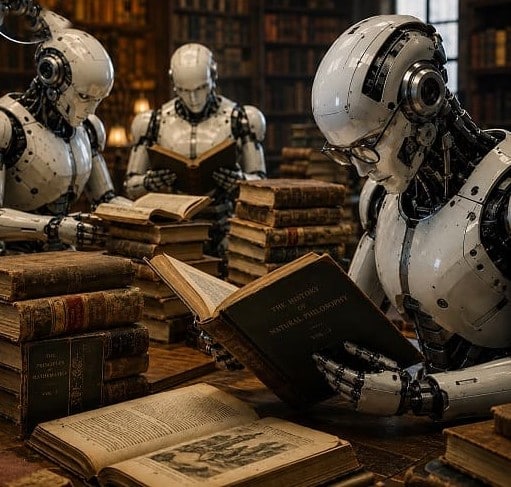
Artificial Intelligence is hungry. Not for faster processors or bigger data centres this time, but for something much older: books.
Recent reports have revealed that AI companies are buying vast quantities of printed books, scanning them into digital formats, and in some cases destroying the originals afterwards to create new datasets for training AI models. The reason is surprisingly simple – many older books contain something that is becoming increasingly valuable in the AI age: genuinely human-written content.
AI Wants Your Old Engineering Manuals – And That Should Get Manufacturers Thinking
Artificial Intelligence companies are increasingly searching for something that many engineering and manufacturing businesses have tucked away on shelves, in archives, or stored in filing cabinets: technical knowledge.
Recent reports suggest AI developers are purchasing large quantities of books and specialist publications to digitise and use as training data. The focus isn’t just on mainstream books. They’re particularly interested in highly detailed, human-created content that contains expertise, context and accuracy that can’t always be found on today’s internet.
For engineering, manufacturing and technical organisations, this trend highlights an important truth:
Your knowledge could become one of your most valuable business assets.
Why Are AI Companies Buying Books?
Modern AI systems rely on huge amounts of training data. Traditionally, much of that information came from websites, articles and publicly available online content.
However, the internet is increasingly filled with AI-generated text. This creates a challenge known as “model collapse”, where AI systems are trained on content created by other AI systems, potentially reducing accuracy and originality over time. Older printed books, especially those published before the recent AI boom, provide a rich source of human-authored content that hasn’t been influenced by AI-generated material.
For AI developers, these books offer:
- High-quality written language
- Subject-specific expertise
- Historical knowledge and context
- Human creativity and expression
- Content that may never have been digitised before
In short, they are becoming a premium resource in the race to build better AI.
The Unexpected Side Effect
Booksellers around the world have reported unusual purchasing patterns, with seemingly random collections of specialist, out-of-print and niche books being bought in bulk. Researchers believe many of these purchases are linked to AI training projects seeking unique content unavailable elsewhere online.
While digitisation itself isn’t new, concerns are growing about the loss of physical copies. Some reports suggest books are being scanned using destructive processes that remove bindings to speed up scanning, with originals subsequently discarded.
This raises an important question:
If a book is scanned and destroyed, has its knowledge been preserved, or has something valuable been lost?
It’s About More Than the Words
A digital copy may preserve the text, but books are often more than just information.
Local history books, technical manuals, regional publications and specialist research documents can be incredibly difficult to replace once physical copies disappear. Many of these works have limited print runs and may only exist in small numbers.
For historians, researchers and future generations, the original publication often carries value beyond the words on the page.
This isn’t simply an AI issue. It’s a wider conversation about digital preservation, ownership, copyright and how society balances technological progress with cultural heritage.
What Does This Mean for Businesses?
For SMEs, the story highlights a broader lesson about data.
Just as AI companies are searching for high-quality information, businesses should be thinking about the quality of their own data assets.
Whether it’s:
- Customer records
- Technical documentation
- Procedures and processes
- Intellectual property
- Historical project information
The organisations with the best data are often the organisations that gain the most value from AI.
As Microsoft Copilot, AI assistants and automation tools become more common, businesses that maintain accurate, well-organised information will be better positioned to benefit from these technologies.
The Manufacturing Knowledge Gap
Across the engineering sector, succession planning is becoming increasingly important.
A maintenance engineer may know exactly why a production line occasionally fails.
A quality manager may understand the historical reasons behind a specific manufacturing process.
A design engineer may have years of experience solving customer challenges that never make it into official documentation.
Without proper knowledge capture, that expertise can be lost.
This is where modern AI technologies such as Microsoft Copilot and AI-powered knowledge management solutions can provide significant benefits.
Rather than replacing skilled engineers, AI can help organisations:
- Surface technical documentation faster
- Search years of project records in seconds
- Assist with troubleshooting activities
- Identify relevant procedures and specifications
- Improve employee onboarding
- Make specialist knowledge more accessible across teams
The result is less time searching for information and more time solving engineering problems.
AI Is Only as Good as the Data Behind It
One of the most overlooked aspects of AI adoption is information quality.
If your documentation is inconsistent, duplicated or outdated, AI tools will struggle to deliver useful results.
Before implementing AI, manufacturers should focus on:
Organising Technical Documentation
Ensure drawings, specifications, procedures and manuals are stored securely and consistently.
Protecting Intellectual Property
Engineering knowledge is often commercially sensitive. Any AI strategy must include strong security controls and permissions management.
Creating a Single Source of Truth
When staff access different versions of procedures or technical documents, mistakes become more likely.
Modernising Information Storage
Systems such as Microsoft 365, SharePoint, Entra ID and Intune can provide secure foundations for managing business-critical information while supporting modern AI capabilities.
What This Means for Engineering Businesses
The story about AI companies buying old books isn’t really about books.
It’s about knowledge.
The organisations that will gain the greatest benefit from AI aren’t necessarily those investing the most money in AI tools. They’re the businesses that have the best data, best documentation and best processes.
For engineering and manufacturing firms, there is a huge opportunity to turn decades of accumulated expertise into a strategic advantage.
The question isn’t whether AI can help your business.
The question is whether your business information is ready for AI.
The EC Computers View
Many engineering and manufacturing businesses are sitting on a goldmine of technical expertise, but much of it remains locked away in disconnected systems, paper records and departmental silos.
As AI becomes more widely adopted, organisations that can securely organise, protect and access their knowledge will be in a far stronger position than those starting from scratch.
At EC Computers, we help engineering and manufacturing companies build the foundations that make AI practical, secure and genuinely useful—from Microsoft 365 and SharePoint through to Microsoft Copilot, Cyber Security, Entra ID and Intune.
Before asking “How can AI help us?”, it may be worth asking:
“How well do we manage the knowledge we already have?”
Thinking About AI for Your Business?
If you’re exploring Microsoft Copilot, AI-powered productivity tools, or want to ensure your business data is ready for the next generation of technology, EC Computers can help.
Get in touch with our team for practical, jargon-free advice on introducing AI securely and effectively into your organisation.