
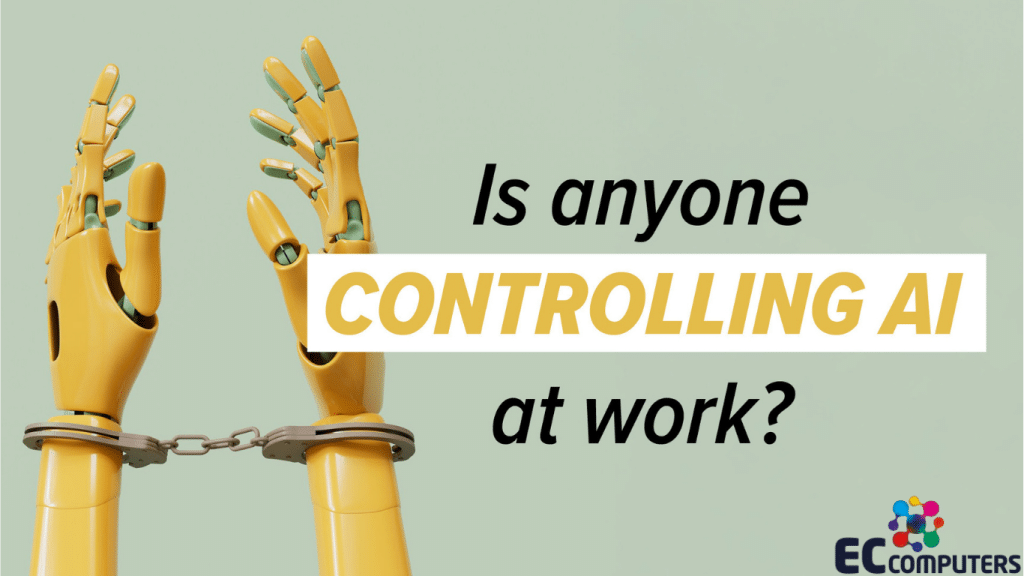
Here’s something we’re seeing more and more when talking to business owners.
AI is already being used across their organisation — but leadership has very little visibility of it.
Staff are using AI tools to save time, work faster, and get through busy days. On the surface, that sounds positive. But without clear guidance or controls, it can introduce risks that most businesses don’t realise are building in the background.
AI has slipped into everyday work
Generative AI tools like ChatGPT and Gemini have become part of normal working life remarkably quickly. People are using them to write emails, summarise notes, create proposals, and think through problems.
The technology itself isn’t the issue.
The challenge is that many businesses never stopped to decide:
- Which AI tools are acceptable for work use
- What information should never be shared with them
- Whether those tools are tied to company accounts or personal ones
Without those decisions, AI use becomes invisible.
What “shadow AI” really means
A large proportion of AI usage at work happens through personal accounts or unapproved tools. This is often referred to as shadow AI.
From a business point of view, that means:
- Data is being uploaded into systems you don’t manage
- There’s no audit trail
- No visibility for IT or leadership
Employees aren’t trying to cause problems. In most cases, they simply don’t see the risk in copying and pasting information into an AI prompt.
But that information can include client data, internal documents, pricing, or commercially sensitive details — all leaving the business without any safeguards in place.
Why this creates real risk for businesses
When AI tools sit outside company control, they create a new kind of insider risk. Not malicious — just unintentional.
We often hear business owners say, “We’re not worried about hackers.”
What catches them out is data drifting out through everyday actions.
There’s also a compliance angle. If your business handles customer data, contracts, or regulated information, uncontrolled AI use can put you at odds with your own policies — or someone else’s requirements — without anyone realising until a problem arises.
Why banning AI doesn’t work
Trying to block AI completely is rarely effective. People will still find ways to use it, especially when it helps them do their job more efficiently.
At the same time, treating AI as harmless isn’t realistic either.
The sensible middle ground is clear, practical AI governance.
What good AI governance looks like
For most small and mid‑sized businesses, AI governance isn’t complex or heavy‑handed. It usually means:
- Agreeing which AI tools are approved for work use
- Setting clear rules around what data can and cannot be shared
- Making sure AI tools are used through business‑controlled accounts where possible
- Educating staff so they understand the risks without feeling policed
When people know the boundaries, they tend to work within them.
Turning AI into a business advantage
AI isn’t going away — and it shouldn’t. Used properly, it can be a genuine productivity booster.
The key is making sure it’s working for your business, not quietly exposing it to risk.
At EC Computers, we help businesses understand how AI is being used in the real world, put sensible controls in place, and support teams so AI becomes a safe, useful tool rather than an unknown liability.
If you’re not sure who’s controlling AI in your business, it’s probably time to take a closer look.