
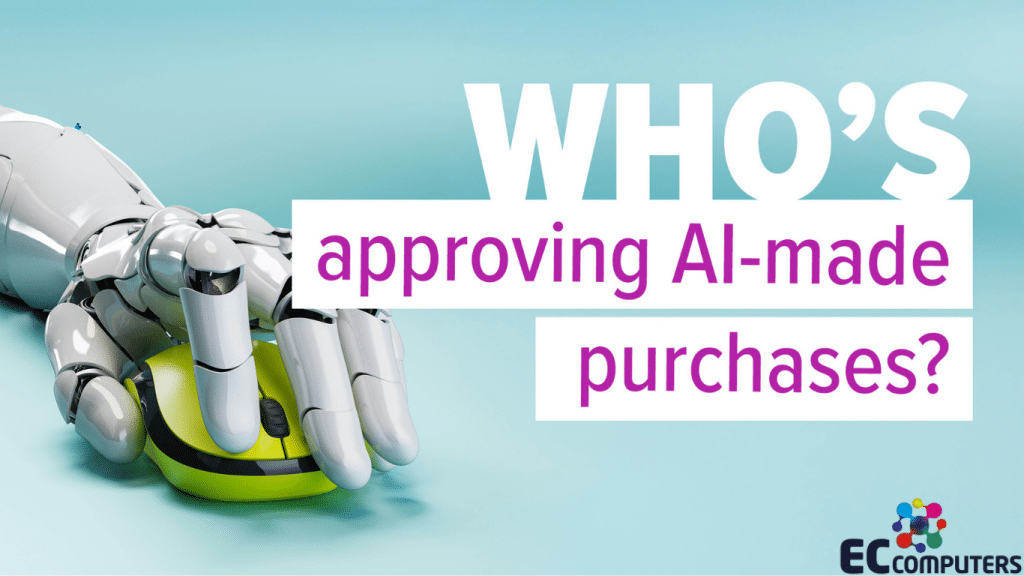
AI tools are already part of everyday working life. Your team uses them to write emails, summarise documents, research answers, and speed up routine tasks.
But there’s a shift happening that many business owners haven’t noticed yet.
AI isn’t just helping people work.
It’s starting to buy things.
Buying without visiting a website
Traditionally, purchasing for a business has friction built in — and for good reason. There are supplier checks, approval steps, budgets, and accountability.
AI tools are beginning to remove that friction.
New features in tools like Microsoft Copilot allow users to research products, see recommendations, and complete purchases without ever leaving the chat window. No browser. No checkout page. No familiar pause that makes someone stop and think.
From a convenience point of view, it’s impressive.
From a business control point of view, it’s concerning.
Why this matters for businesses
When purchasing becomes quick and effortless, spending naturally increases. Microsoft’s own data shows that people are more likely to complete a purchase — and do it faster — when AI tools are involved.
That’s great for sellers.
But it can quietly inflate costs for businesses if nobody is watching.
Even more importantly, AI‑driven purchasing can bypass:
- Approval processes
- Preferred supplier lists
- Budget controls
- Visibility over who bought what, and why
If employees don’t know the rules, they’ll assume there aren’t any.
The data and security angle
To make AI checkout work, payment details, delivery information, and account data all come into play.
The platforms involved may be reputable, but the real question isn’t whether the technology works — it’s whether your policies account for it.
Ask yourself:
- Which payment methods are allowed?
- Are purchases logged centrally?
- What information can AI tools access or reuse?
- Who is accountable if something goes wrong?
Without clear answers, risk builds quietly in the background.
This isn’t about banning AI
AI‑powered purchasing isn’t automatically bad. In fact, it could be very useful in the right situations.
The real issue is accidental adoption.
These features don’t arrive with loud announcements telling you to update your policies. They simply appear — and get used.
If you want your team to use AI‑made purchases, that decision should be deliberate, documented, and supported with:
- Clear rules on who can buy
- Limits on what can be purchased
- Approved accounts and payment methods
- Visibility and reporting
- Staff guidance that convenience doesn’t remove responsibility
And if you don’t want it used, that needs to be just as clear.
Decide before it decides for you
The real question isn’t whether your team can use AI to make purchases.
It’s whether you’ve decided if they should.
At EC Computers, we help businesses stay productive, secure, and in control as technology evolves — without nasty surprises appearing on the balance sheet later.